
This section covers schematic parts, wiring, net labels, and the bill of materials (BoM) in Flux.
Import Your KiCad Project
Attach your KiCad project files, or a ZIP file of the project folder, to a message in the Chat panel. Ask Flux to import them. Flux creates a new project from the files.
To do it in the UI:
In Flux, select Import from the Flux menu, then select Project…. Upload your KiCad .kicad_pro, .kicad_sch, and .kicad_pcb files, a project folder, or a ZIP file. Each import creates a new project. It does not update an existing project or part.
Overview
Key differences when you move from KiCad to Flux:
Find KiCad symbol properties in the Inspector panel in Flux. It includes datasheet links, part properties, and pricing.
KiCad uses labels to connect nets. Flux uses net labels and power symbols that connect pins with the same net name.
Working with Parts on the Schematic
In KiCad
In KiCad, part properties like designators, datasheets, etc., are directly accessible via the symbol properties.

In Flux
Ask Flux about the properties of the parts, or ask Flux to change them.
To do it in the UI:
Open the Inspector panel to view component properties:
Properties: View part metadata, including manufacturer part numbers.
Availability and pricing: View pricing and availability for parts with an MPN.
Assets: Add external assets, such as symbols and thumbnails, to projects or parts.
For parts that contain a Manufacturer Part Number property, Flux adds live pricing and availability information from the main distributors (DigiKey, Mouser, etc.). Pricing and availability
Wiring Parts
In KiCad
In KiCad, you connect parts using wires, labels (global and hierarchical), and power symbols.

In Flux
Ask Flux to connect the parts.
To wire by hand:
Connect parts with wires, net labels, and power symbols:
Wires: hover over a part and click on the circle that appears at the end of the pin to create a wire.
Net labels: start a wire from a pin that has no connection. A menu opens next to the pin. Select Create a net or connect to an existing net and type the net name. Pins with the same net name are connected.
Power and ground symbols: Flux shows a power symbol for a net whose Net Type property is Power. To connect a pin to ground, select Connect to the GND net in the same menu.
Integrated version control lets you revert to previous states if you make a mistake while wiring.
Managing the Bill of Materials (BoM)
In KiCad
You can generate your BoM using the “Generate BoM” menu. BoMs are generated based on customized scripts.

In Flux
Ask Flux to read or export the BOM.
To do it in the UI:
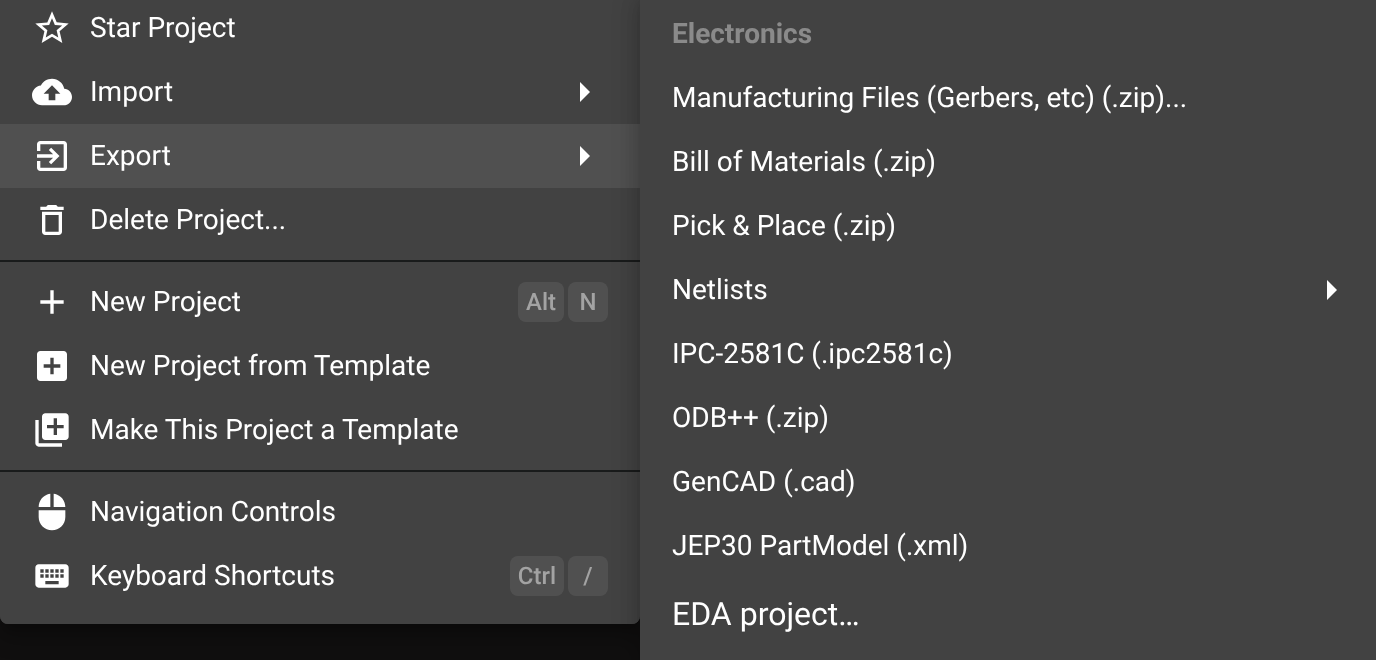
BoMs are automatically generated and exportable in various formats for the main manufacturers.
Ask Flux
Ask Flux to do this work in your imported project.
Review the imported design
Ask Flux to review the schematic and the board. Flux reads the datasheets of the parts and reports the problems that it finds, with a fix for each one. Flux can also make a failure mode and effects analysis (FMEA) report.
Simulate the circuit
Ask Flux to simulate a part of the schematic. Flux runs transient, AC, DC, and operating point analyses and shows the plots. See Circuit simulation.
Next in the KiCad to Flux tutorial -> Layout (KiCad to Flux)